Oh No There Goes That Rain Again Chords Ben Harper
In November 2013, Ben Harper emotes at Davies Symphony Hall in San Francisco, in a concert that as well teamed him with dejection harmonica legend Charlie Musselwhite. "I put a lot into the words," the guitarist asserts.
With his Innocent Criminals back together for a new album, Call Information technology What It Is, the lap slide guru talks about his roots, songwriting, collaboration, and the mysteries of reggae and Neil Young.
In 2008—after nigh a decade of making roots-based music get pop, and winning two Grammys forth the manner—the collective consciousness of Ben Harper and the Innocent Criminals had started to fade. Both personally and musically, the band was failing to evolve and grow. It was time for a change. So Harper focused more on his hard-rocking Relentless7 group along with some select solo projects.
Among those projects was a pair of albums that had been on Harper's list for a while. He paired up with an elderberry statesman of the blues, harmonica legend Charlie Musselwhite, for Become Upward!, a fantastically authentic straight-upwardly dejection anthology that was as honest and well-executed every bit anything in either creative person'due south itemize. Harper says that a sequel to the Grammy-winning collaboration is in the works. On the flip side, Babyhood Habitation, a collection of tunes with his mother, Ellen, brought his sphere of influences full circle. "I don't think I would have fifty-fifty been ready to do it until a year or two ago," states Harper. "Of grade, we all love our parents and nosotros dear our mom, but I just saw her clearly every bit a peer and equally a person in a style that I hadn't up to that indicate. That anthology is a commemoration of family unit."
In late 2014, Harper announced he was going to round up the Innocent Criminals for a run of shows at San Francisco'due south Fillmore. "I didn't desire to option upwardly where we left off," he says. "I tin't see the growth in that." But from the outset it was obvious this wasn't a reunion with a goal of headlining the latest trendy festival. It became an development—perchance fifty-fifty a rebirth—of the group that truly put Harper on the map.
The eventual goal, fifty-fifty from the earliest sessions, was to create the next affiliate rather than rehash the hits that brought the fans in. Call It What Information technology Is expands on the grouping's strengths, moving seamlessly between genres without a hint of irony or lack of conviction. The opening track, "When Sex Was Dirty," combines socially enlightened lyrics with a sing-forth chorus, syncopated riffs, and a classic rock staple: the cowbell. "Outside the studio with the door closed, that cowbell would have still been too loud," says Harper. "That matter was cutting through every microphone." With "Polish," the bands tackles a mod Stax vibe stoked by keyboardist Jason Yates' infectiously perfect Rhodes grooves. And the varied beat out goes on, with the Tom Waits-turns-country feel of the dark title track—a meditation on killings past police—and the garage-stone grind of "Pinkish Balloon."
Overall, the Innocent Criminals—which also includes percussionist Leon Mobley, bassist Juan Nelson, drummer Oliver Charles, and guitarist Michael Ward—is a rare musical outfit that is truly greater than the sum of its parts. The genre-hopping Criminals are but true to themselves. "We don't have ten songs of ane genre; I never have," allows Harper. "When it's time to brand a record, I have written songs in dissimilar styles whether they be dejection, punk rock, soul, funk, or folk." During preparations for his 2016 tour, we defenseless up with Harper to discuss his life every bit a songwriter, how legendary amp guru Howard Dumble helped him discover his tone and melody up his pinball game, and why the Innocent Criminals have become his most effective creative outlet.
What was the vibe like dorsum in '08 when you decided to take a break from the Innocent Criminals? Did you feel that era had run its course?
Yes. We hit a betoken with each other, with the music, with the creative process, that required u.s. to become some distance from everything so nosotros could actually see what it was that we had and were doing or not doing. But in that location was a footling bit of personal running-in-place. It is difficult to … How can I put this? It's hard to grow while you're not actually recognizing what y'all are growing towards. They are such monster players equally well. I but call back nosotros had reached a point where maybe nosotros were creating barriers for each other and non creating open roads and opportunities creatively.
Practice you retrieve it was more than musical or personal?
I call up it was both. There was some taking each other for granted and that'south where it'due south hardest to grow. There was no other way but to take time off. I never said, "I am breaking upwardly the Innocent Criminals." It was but time for all of u.s. to do something different. It sure felt like a intermission-up, but it wasn't, and that is why we were able to remain in advice with each other. And it wasn't easy, that's for sure. It haunted me.
"Some sounds are out there waiting for the player. Why would anyone want to play the tuba? I don't know, just people have devoted their lives to the tuba. There's a audio out there for everybody and [the Weissenborn] was the audio for me."
Throughout your career yous've focused on writing songs for yourself. Obviously, that cloth is very personal. Have y'all ever had an involvement in writing for other artists?
I mainly write for myself and the dialogues that I've been having with specific groups of people. There's this privilege to be able to grow together through music with people around the world. I experience so lucky for that. I have but written specifically for other artists a couple of times. I wrote a song for Taj Mahal. I wrote a song recently that is coming upwardly on Mavis Staples' new tape.
What does it experience like to hear another artist cover one of your songs?
It's the best feeling in the world. It actually makes you feel like a songwriter, which is keen, because I practise put a lot into the words. Some lyrics may seem deceptively simple, but they are edited down from a lot of pages of ideas. Then when yous hear someone actually encompass 1 of your songs in the wild, information technology's only the best. I call up any songwriter will tell y'all that. I have not grown immune to how exciting that is.
Why was it important to you to view this reunion with the Innocent Criminals as a new chapter?
I couldn't practise 10 "Steal My Kisses." I couldn't practise it. I have never done annihilation formulaic in my life. Every song and lyric I write, I hateful. Every collaboration with the Innocent Criminals strikes as deep as we can. We exit no stone unturned and by the end of the procedure we are all wearied. It's all nigh bringing forrad our strongest textile and taking risks. We have never played it safe as a band. We have e'er had polarizing songs and songs that somehow were different in genre, but at that place was a through-line in the way this band interprets dissimilar genres.
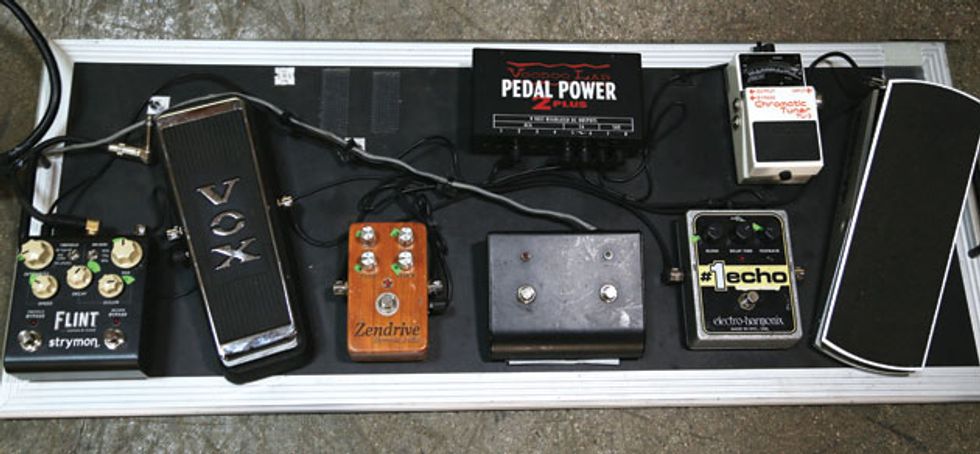
With the exception of a holy grail Overdrive Special amp by Howard Dumble, Ben Harper'south rig is fairly elementary, with a tuner, volume pedal, reverb/tremolo, overdrive, channel switcher, digital delay, and power unit on his pedalboard.
Photo past Adam Keely
This band's ability to fluently and authentically move between genres is remarkable.
Information technology'southward the songs, man. I accept every Ramones record. I have every Dead Kennedys tape. Juan is the funk. Leon'due south roots are Africa, reggae. These are the influences of this band and the songs that we write and the way that nosotros craft music. That is all we are going for. There have been a couple of times where, like the Get Up! anthology with Charlie Musselwhite, I've gone into my archive of blues cloth and the timing was right. Same with the Bullheaded Boys of Alabama record [2004's collaborative There Volition Exist a Low-cal]. Some of them, like the folk record with my mom—that took she and I both digging into our annal of songs in that style to put that record together. I wouldn't have had an unabridged record of folk music that I could actually publish, that I could be proud of, on my own. It'due south more about the songs that I take and picking the ones that I feel strongest about regardless of way.
Say for this record, I had twenty songs. Nosotros recorded a proficient number of them until nosotros started to see the ones that were raising their hands the highest and sitting together the best. Information technology's natural selection in the studio. The ones that stand up, stand up proud—and what starts to happen is you get sister songs. There is a song called "When Sex Was Muddy," which is a sister song to "Pink Balloon." There's a song called "Dance Similar Fire," and that's a sister song to "Bones." "Bye to You" is percussively linked to "How Night is Gone." All of a sudden, songs outset to pair up with each other and that really helps in the sequence. Information technology'south a big hazard this twenty-four hour period and age to make an entire body of work that is eclectic because we are in the era of judging an creative person by his song. That has been coming on twelvemonth by yr and now it is more prevalent than always. Maybe it will be to my demise or possibly information technology will be my freaking calling card and strength. I am counting on it beingness a strength and I am counting on somehow people finding information technology as an entire body of work. Perhaps information technology is just a pipe dream, I don't know.
As strongly as I believe in a body of work, still, it is time that people start honing the fine art of putting a body of work together. The days of 13-, 14-, xv-song albums are gone. Come up with a tight 10 or xi songs and I retrieve you will stand up a improve chance of introducing people to a larger trunk of work. Setting limits on yourself is a big part of making a record.
Is the hardest part of making an album the cocky-editing procedure?
It's and so hard with this ring, because we get emotionally attached to songs. We had a listening party of mayhap 20 people, and Chris Rock was there. The concluding vocal on the record is "Goodbye to You." There used to exist ii songs after that. After that song he said, "That's it. Don't play some other song. That'southward where this record needs to cease." He was right. I felt dandy about the ii songs after that, simply Chris and Ethan Allen, who co-produced the album with the band, were right. Ethan is really the North Star, and those objective opinions kind of reeled united states of america in.
Did you take songs prepare for this anthology or did some of them come up through rehearsals?
I wanted to see what information technology was going to audio and experience similar when we got back together. I didn't want to pick up and only first rehearsing old material. I wanted to pick up where we had all grown to. Everybody got together for a week at the Hamlet [studios] in Los Angeles. I presented a couple of new songs, and the way that the band just leaned into them, working off each other, it was something and then different. I knew it was on. I but needed to get all of us in a room and move into that new direction. That week prepare the phase for the tape and having the group dorsum together and really having the time of our lives creatively.

Sitting downward on the task is a requirement for Ben Harper, since he's all-time known for his lap slide guitar playing. But his fiery performances and songs that often explore social issues, like his new album'due south title track, keep his audience on its feet. Photograph past Joe Russo
Y'all spent your formative years around your family'southward music store in Claremont, California. Did you lot work on instruments?
I did. I was a bona fide luthier.
Is that something you go on upwards on?
In a word, no, only I do get out and work in my family's music store quite often, and information technology'due south always the best feeling to be back in the shop and having my hands on instruments. It as well comes in handy on the road.
The audio-visual Weissenborn guitar has become nearly synonymous with your fashion. Did you lot stumble upon it at your family unit's shop?
That was it. Nosotros were one of the rare stores that actually recognized them. People used to come up in and, because they couldn't fret them, would endeavor to play them like regular guitars. Imagine, in 1958, my grandparents actually recognizing that Wiessenborns were a unique contribution to the acoustic instrument pantheon. David Lindley got his first Weissenborn from my grandad.
Ben Harper'southward Gear
Guitars
• Asher Ben Harper Signature Lap Steel
• 2010 Gibson Custom Shop Les Paul Special
• 1954 Fender Hardtail Stratocaster
• Martin HM Ben Harper Special Edition acoustic/electric
• Weissenborn Style iv Lap Steel
Amps
• 2010 Dumble Overdrive Special
• Fender Princeton
Furnishings
• Strymon Flintstone Tremolo & Reverb
• Vocalization wah
• Hermida Audio Zendrive
• Electro-Harmonix #1 Echo digital filibuster
• Boss TU-3 tuner
• Ernie Ball volume pedal
• Voodoo Lab Pedal Ability 2 Plus
Strings and Picks
• D'Addario EJ16 Phosphor Bronze Lights (.012–.053; acoustic)
• D'Addario EJ17 Phosphor Statuary Medium (.013–.056; lap steel)
• D'Addario EXL 115 Nickel Wounds (.011–.048: electric)
• Dunlop Picks
• Dunlop Ben Harper Signature Tone Bar

What specifically well-nigh that instrument spoke to you lot?
I don't know. I had every guitar at my fingertips. Although the guitars that I wanted to consider mine, my grandfather made me pay for, so I had to work them off. I've played Dobros, Nationals, Triolians, Duolians, Regals, and all the resonators. Everything from African koras to sitars were at my disposal. In that location was just something about that freaking Weissenborn. From the time I could hear information technology, I would just gravitate towards it. Some sounds are out there waiting for the thespian. Why would anyone want to play the tuba? I don't know, but people have devoted their lives to the tuba. There's a sound out there for everybody and that was the sound for me.
How do yous wrestle with the Weissenborns at stage volumes?
I kinda stopped trying to force the Weissenborns upwardly above the band. That's where Billy Asher [of Asher Guitars and Lap Steels] and I co-designed my lap steel. Information technology's a hollowbody with a maple cap, like a Les Paul. It still has this hollow nature, but I don't have to struggle to get over the band. On certain songs I will still crank the Weissenborns up. It's always fun. I brand sure I accept it out for near a quarter of the ready on the dejection stuff, similar "Homeless Child," "Welcome to the Cruel Earth," and "Requite a Man a Home."
What tunings did you use on the anthology?
I am all over the map. Mainly versions of open D (D–A–D–F#–A–D) and "Spanish" K (D–Grand–D–G–B–D). I volition take the open D tuning and motility it downwards to C and so I volition tune the Spanish Chiliad up to A or B. I will even get as loftier as F on a Weissenborn in the D tuning with lighter strings.
When did you go caught up in the sphere of Dumble amps?
From the time I was probably ix years old onward, I grew up next door to David Lindley. David'south daughter, Rosanne, and I were thick as thieves. Every once in awhile David and his band at the time, El Rayo-X, would have rehearsals at a identify chosen the Alley. David would bring Rosanne and I to rehearsals. I was about 10 or 11 and was at a rehearsal playing the pinball machine. This super-generous dude was giving me pointers on how to shake the machine and how to get the best of it. Information technology was Dumble. He and I first met huddled around a pinball machine. When I started actually jumping into tone, would you lot believe that he remembered me from that? Dumble and I accept been at information technology awhile.
How did you get your kickoff Dumble?
He helped me put out feelers for people who had them for sale and I was able to get my hands on 1 pretty chop-chop. So he actually brought me in and let me plug into his oscilloscope, which he rarely does anymore. He took notes on the frequency patterns of my instruments and he built an amp for the sounds that my instruments make. The only reason he charges so much is because the market has insisted. Otherwise he would accuse $5,000 and someone would make $twoscore,000 on his amps. He has no choice. Are Dumbles worth information technology? You listen to [David Lindley's version of] "Mercury Blues" and tell me whether or not it is worth information technology.
Are y'all a big pedal guy? Do you like to tinker with those?
I practise, although I'm going for fewer pedals. Charlie Musselwhite volition say, "Hey, man. Careful when yous are using those pedals and calling it blues [laughs]." He will walk over and glance at my pedalboard and say, "How many of those you gonna use for the blues? How many you need?" And then Charlie got me thinking about relinquishing all pedals. For now, it is real uncomplicated. I've got a [Hermida Audio] Zendrive, Strymon Flint, Electro-Harmonix delay, and that'south about it.
"Finding Our Way" has such an authentic reggae groove. How did you learn about playing reggae guitar? Conceptually, it seems very simple, simply it'due south quite hard to get the right feel.
That skank. Oh homo, it'southward nasty. First, it'due south just in me. 2nd, I have lived reggae music my entire life from Lee Perry and Ernest Ranglin to "Stepping Razor" and "Legalize It" by Peter Tosh. My dad took me to run into Marley when I was 10, and it was a life-changing experience. The only manner I have been able to illustrate what that skank means is to be in the studio and take it out of the mix. The bottom falls out. Information technology's just this weird, mystic thing. I will never understand why Neil Immature's G chord sounds so different than anyone else's in the earth. I don't know man; it's the mystery of the guitar. It only pulls you in.
How collaborative is the band in the studio when it comes to creating parts?
This tape is credited to the band, as far every bit production. Everybody was producing. It was magic. Yous would think it would be too many cooks in the kitchen. I've never been in such an ego-free surroundings. Information technology made yous desire to effort everyone'south ideas fifty-fifty if you idea they were crazy. When someone was driving, like Oliver Charles on those drums, he took the lead. He knew what he wanted, he heard it in his caput, and he found it. Sometimes production is patience, just it's also letting people notice their manner.
Might there exist another hiatus in the futurity?
We won't practice that once again. There might be a couple of other side projects, merely they would be in betwixt Innocent Criminal projects, for certain.
What side by side matter on your list?
I'm going to exit yous with this: instrumental album. [Luthier] John Monteleone. Acoustic lap steel.
YouTube It
Hermann Weissenborn's distinctive guitars are hollow-necked acoustics, and while Ben Harper tin can make them howl similar Hendrix at Woodstock, this solo functioning of the socially pointed title track of his new album, Call It What It Is, showcases the instrument'southward super-warm, amplified natural tone as well every bit Harper'southward fearless lyrics.
ferrellcouspit1953.blogspot.com
Source: https://www.premierguitar.com/artists/guitarists/ben-harpers-arresting-developments
0 Response to "Oh No There Goes That Rain Again Chords Ben Harper"
Post a Comment